English · Nederlands · Deutsch
Buteo buteo · Buizerd · Mäusebussard
Common buzzard
No public tags currently active for this species

About common buzzards
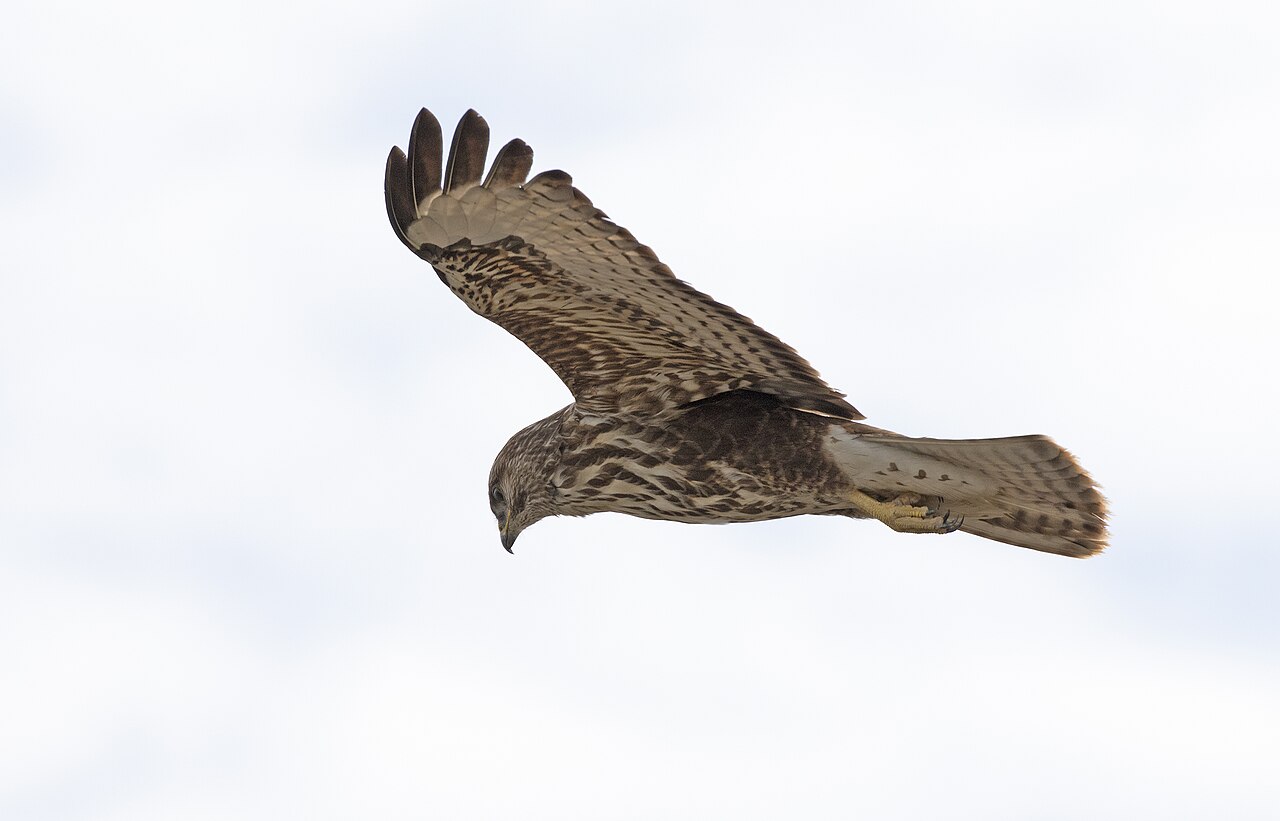
The common buzzard is the everyday raptor of north-west Europe — the broad-winged bird mewing high over a motorway, or hunched on a fence post waiting to drop onto a rabbit. No two look quite alike: plumage runs from almost white to solidly dark brown, and females are noticeably bigger than males. Rabbits matter most by weight, but a buzzard will take moles, voles, starlings, amphibians, reptiles and, in winter, a great deal of carrion.
How common buzzards migrate
Buzzards breeding in Germany and the Low Countries are barely migrants at all: German birds are predominantly resident, the same holds in Belgium, and Dutch breeders largely overwinter in their own country. The streams of buzzards a birdwatcher sees in autumn are therefore mostly other people's birds — Scandinavian, Finnish and Russian breeders that leave in September and October, funnel through Falsterbo in southern Sweden, and cross the Low Countries with a peak usually between 10 and 20 October, when a single count post can log several hundred in a day. Some of those travellers stop and winter here; others carry on to a winter range reaching from central France into Spain. They drift back north in March and April, a thinner and less obvious passage easily confused with local birds shuffling around. The net effect is a country holding roughly twice as many buzzards in midwinter as in summer, layered over a resident population that never went anywhere.
Key facts
- Length
- 40–58 cm (sources disagree)
- Wingspan
- 109–136 cm
- Leaves
- Mostly it doesn't — German, Belgian and Dutch breeders stay put. The visible autumn passage is northern birds, peaking over the Low Countries around 10–20 October
- Returns
- March–April, when Scandinavian birds move back north; spring passage is markedly weaker than autumn's
- Winters in
- Home, for local breeders. Passage birds winter from the Low Countries through central France to Spain; the Dutch winter maximum is 30,000–50,000 individuals
- Changing habits
- Numbers collapsed to a few hundred Dutch pairs around 1970 through pesticide poisoning, then recovered after those substances were banned. Dutch breeding numbers have risen since 1990 while wintering numbers have fallen over the last twelve years — the two trends now point in opposite directions
- Population
- 79,000–135,000 pairs in Germany; 11,500–20,000 in the Netherlands (2018–2020), the country's commonest breeding raptor
Is migration happening right now?
Weather radar over the Benelux and Germany measures how many birds are aloft, updated every five minutes. See it for Belgium, the Netherlands or Germany, or watch every tagged bird on the live map.
Tracking data from open CC0 and CC-BY studies published on Movebank; each bird's page credits its study.