English · Nederlands · Deutsch
Melanitta fusca · Grote zee-eend · Samtente
Velvet scoter
3 tagged birds on this site

- Tracked birds
- 3from open research studies
- Positions
- 890GPS fixes stored
- Tracked between
- 55.9°N – 58.6°Nnorth–south spread
- Latest signal
- 23 Sept 2025across all tagged birds
Where the tracked velvet scoters are now
Each dot is one tagged bird's most recent position.
About velvet scoters
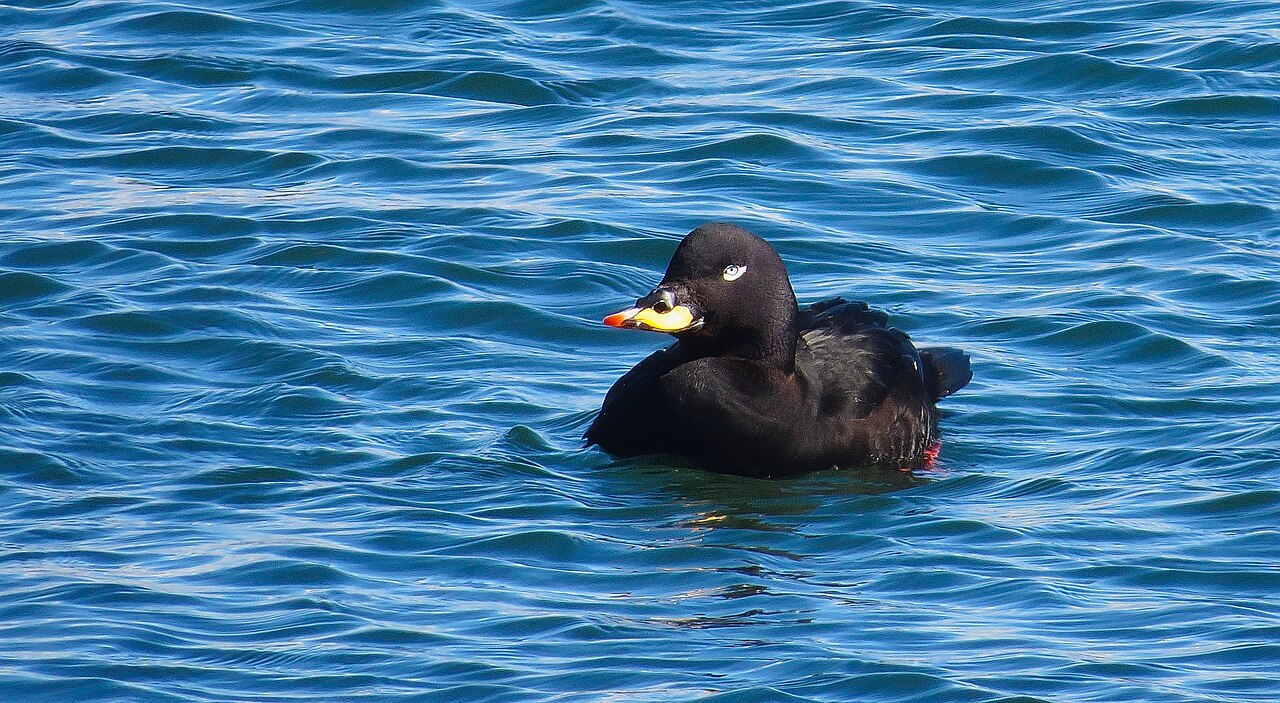
A heavy, low-riding sea duck that spends the winter half of the year out on open salt water. It is easiest to pick out when a flock flushes: the drake is jet black with a small white eye-patch and a partly yellow bill, and both sexes flash a white panel on the trailing edge of the wing. It dives for mussels and cockles down to 30 or 40 metres. Finding one usually means picking a single bird out of a raft of the far commoner common scoter, somewhere near the horizon of a cold North Sea beach.
How velvet scoters migrate
Velvet scoters do not breed in Germany or the Low Countries, so there is no local breeding population whose route could be described. The birds a Dutch or German watcher meets are Fennoscandian, Baltic and Russian breeders, either heading for their winter quarters or already settled in them: the Baltic and the Atlantic coasts of northern and north-western Europe, and in Germany above all the Pomeranian Bay and the Greifswalder Bodden, which is also a moulting area where tens of thousands of scoters gather. On the Dutch side the species is thinly spread, usually mixed into flocks of the much commoner common scoter north of the Wadden Islands and in the Voordelta. The bulk of movement at sea falls in October to December and again in April and May. The documented change here is loss rather than any shift in timing: the Baltic wintering population has been reported to have fallen by about 60% over two decades, and Dutch numbers have declined significantly since 1980.
Key facts
- Length
- 51–58 cm
- Wingspan
- 79–99 cm (sources differ)
- Leaves
- April–May, the main spring passage at sea back towards the northern breeding grounds
- Returns
- October–December is the main autumn passage; in Germany the species is present from October to April
- Winters in
- The Baltic — in Germany above all the Pomeranian Bay and Greifswalder Bodden — and the North Sea and Atlantic coasts of northern and north-western Europe
- Changing habits
- No short-stopping documented; the change is decline. The Baltic wintering population has been reported down about 60% over two decades, and Dutch numbers have fallen since the 1980s
- Population
- No breeding population in Germany or the Low Countries. In the Netherlands 200–800 birds in winter and 500–2,000 on passage
Is migration happening right now?
Weather radar over the Benelux and Germany measures how many birds are aloft, updated every five minutes. See it for Belgium, the Netherlands or Germany, or watch every tagged bird on the live map.
Tracking data from open CC0 and CC-BY studies published on Movebank; each bird's page credits its study.