English · Nederlands · Deutsch
Circus pygargus · Grauwe kiekendief · Wiesenweihe
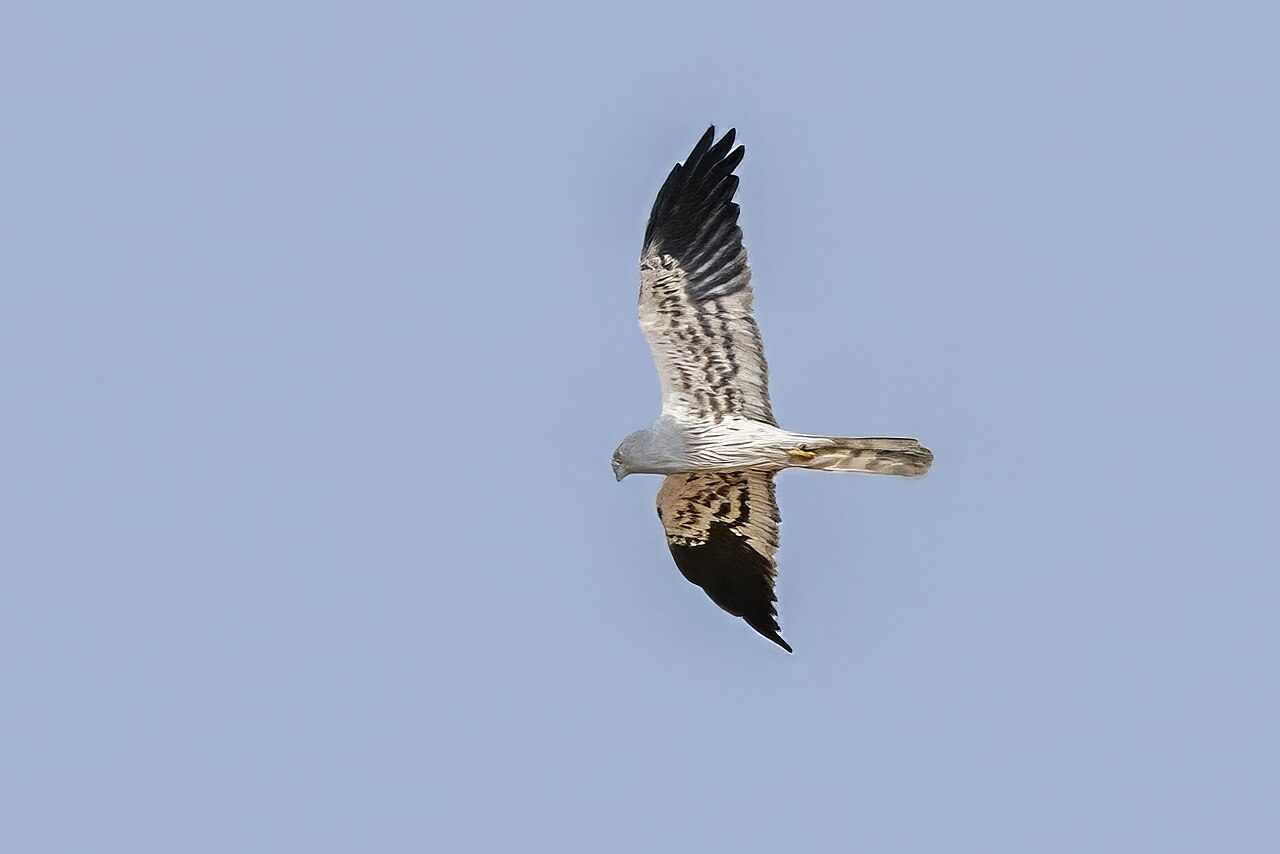
Montagu's harrier
No public tags currently active for this species
_male_in_flight_Kebili.jpg)
About Montagu's harriers
A harrier built like a tern: extremely slender, buoyant, tilting low over the crop, and showing only four fingers at the wingtip where the hen harrier shows five. It is listed as critically endangered in the Netherlands and is the UK's rarest breeding bird of prey. In Germany and the Low Countries it now nests almost entirely in standing cereal, its year measured in the weeks between hatching and the combine harvester.
How Montagu's harriers migrate
Every Montagu's harrier breeding in Germany or the Low Countries leaves for Africa. Departure runs from late July through September — satellite-tagged Dutch birds set off between 16 August and the last week of August in 2025 — and the route goes overland south-west through France and Spain, across the Strait of Gibraltar into Morocco and then over the Sahara, though one tagged female instead struck out over open sea north of Barcelona. Winter is spent in the Sahel south of the desert, with tagged birds stopping in Mali and Niger and one settling again on its regular site at a Nigerian reservoir. Return migration begins in March and the birds are back from mid-April into May. No short-stopping or European wintering is documented for this species; the change on record is where they nest rather than where they winter. Since the early 1990s they have followed the draining of their moors and wet meadows into arable land, so that over 90% of Bavarian nests are now in grain and most broods survive only because volunteers find and protect them before the harvest.
Key facts
- Length
- 39–49 cm (sources differ)
- Wingspan
- 102–123 cm (sources differ at the top end)
- Leaves
- Late July to September; tagged Dutch birds departed between 16 August and the last days of August in 2025
- Returns
- Migration starts in March; birds are back on the breeding grounds mid-April to May
- Winters in
- The Sahel south of the Sahara; tagged Dutch birds wintered in Mali, Niger and Nigeria
- Changing habits
- Moved off drained moors and wet meadows into arable cereal from the early 1990s; over 90% of Bavarian nests are now in grain, and broods depend on volunteers protecting them before the harvest
- Population
- 51 pairs in the Netherlands (2025), after a fall from several hundred to about 15 around 1990; 400–550 in Germany and increasing; at most a few breeding attempts a year in Flanders
Is migration happening right now?
Weather radar over the Benelux and Germany measures how many birds are aloft, updated every five minutes. See it for Belgium, the Netherlands or Germany, or watch every tagged bird on the live map.
Tracking data from open CC0 and CC-BY studies published on Movebank; each bird's page credits its study.