English · Nederlands · Deutsch
Ichthyaetus melanocephalus · Zwartkopmeeuw · Schwarzkopfmöwe
Mediterranean gull
1 tagged bird on this site

- Tracked birds
- 1from open research studies
- Positions
- 300GPS fixes stored
- Tracked between
- 50.7°N – 50.7°Nnorth–south spread
- Latest signal
- 24 Feb 2026across all tagged birds
Where the tracked Mediterranean gulls are now
Each dot is one tagged bird's most recent position.
About Mediterranean gulls
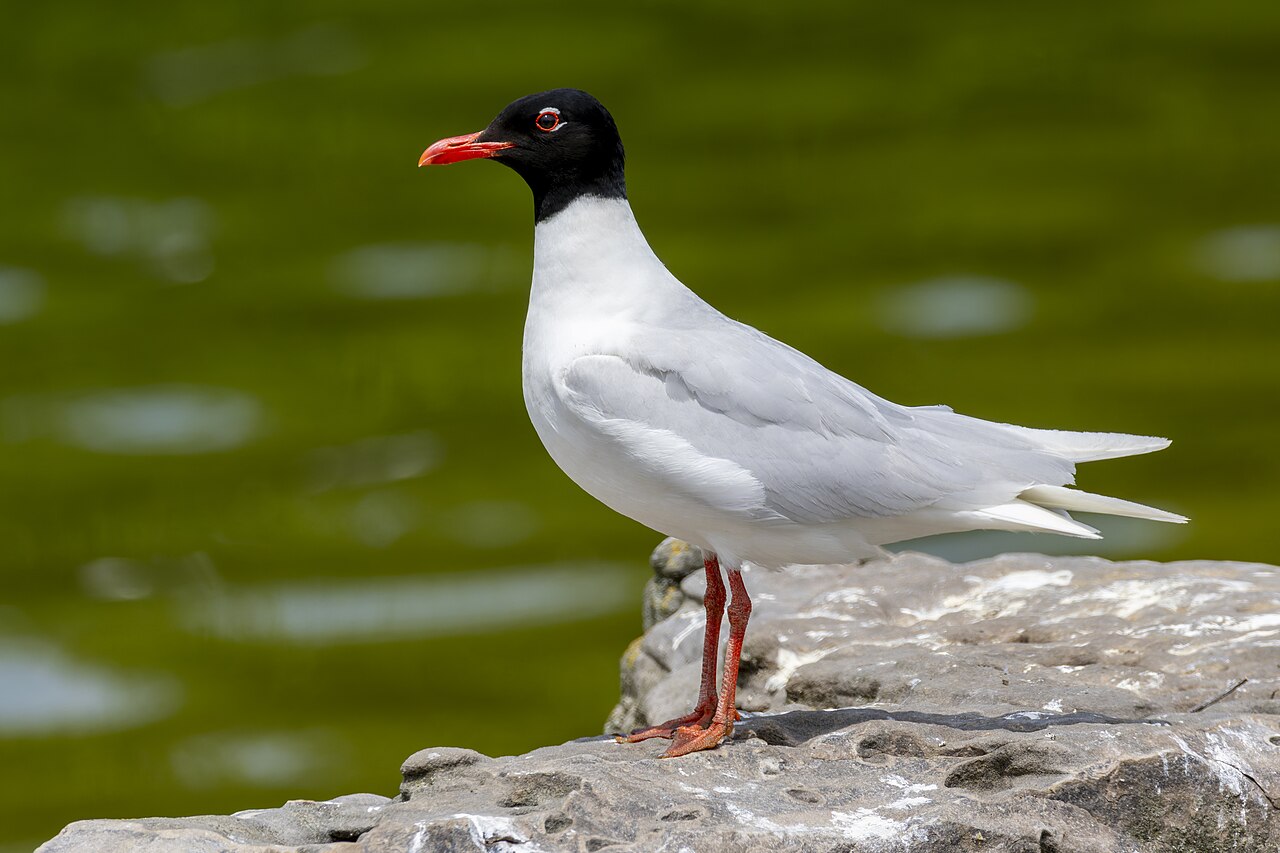
Look twice at a flock of black-headed gulls on a Dutch or German coast and you may find something better: a gull with a jet-black hood, a blood-red bill and legs, and wingtips of pure unbroken white. It is only a shade larger than the birds it hides among, which is exactly why most people walk straight past it. It is also a newcomer — a Black Sea species not recorded breeding in Germany until 1951, and now nesting in the Dutch delta by the thousand.
How Mediterranean gulls migrate
Mediterranean gulls from Germany and the Low Countries are short-distance migrants rather than long-haul travellers. Birds begin leaving the colonies from mid-July and move north-west and south-west towards France, the Low Countries and Britain, mostly along the coast, by day, in loose groups. The wintering range is broad: the Mediterranean and Black Sea, but equally the Atlantic and Channel coasts of north-west France, Portugal, the British Isles, the Netherlands and Belgium. Return movement starts in mid-March, with breeders back during April. The species' whole centre of gravity has shifted west within a human lifetime — originally a Black Sea bird, it spread through south-east and central Europe and was first recorded breeding in Germany only in 1951, while in Britain it went from a great rarity before the 1950s to a widespread bird today.
Key facts
- Length
- 37–40 cm
- Wingspan
- 94–102 cm
- Leaves
- From mid-July; colonies empty through July and August, with birds still moving into September
- Returns
- From mid-March, most breeders back during April
- Winters in
- The Mediterranean and Black Sea, plus the Atlantic and Channel coasts of western Europe
- Changing habits
- Colonised north-west Europe from the Black Sea within living memory — first German breeding record 1951 — and now winters much closer to home, with 30–60 birds staying in the Netherlands
- Population
- 4,800–5,000 pairs in the Netherlands (2025), rising more than 5% a year since 1980; roughly 280–500 pairs in Germany, depending on the source
Is migration happening right now?
Weather radar over the Benelux and Germany measures how many birds are aloft, updated every five minutes. See it for Belgium, the Netherlands or Germany, or watch every tagged bird on the live map.
Tracking data from open CC0 and CC-BY studies published on Movebank; each bird's page credits its study.