English · Nederlands · Deutsch
Circus cyaneus · Blauwe kiekendief · Kornweihe
Hen harrier
No public tags currently active for this species

About hen harriers
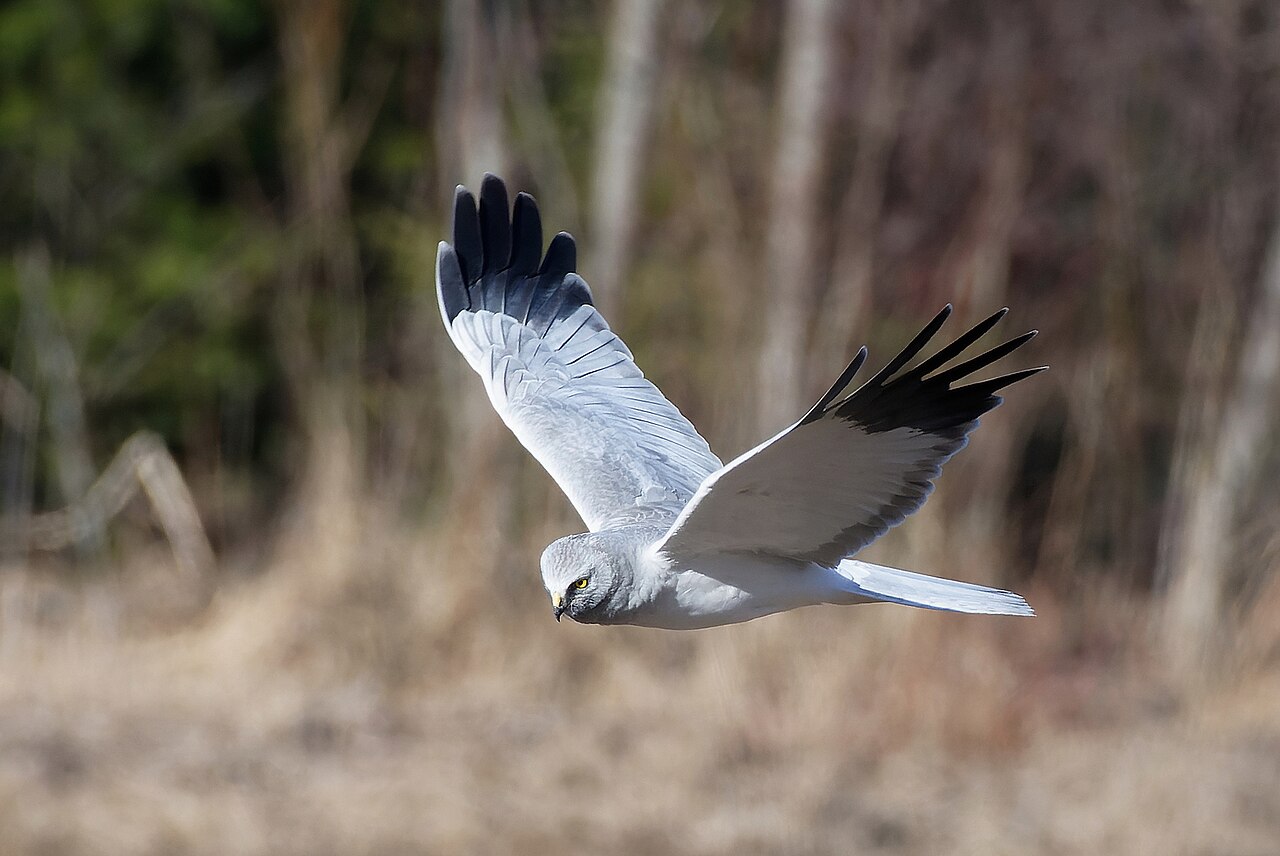
A hen harrier hunts the way nothing else does over a winter polder: slow and tilting, wings held in a shallow V, quartering the rough grass barely a wingspan above it. The male is pale blue-grey with sharply dipped black wingtips; females and young birds are brown and barred, and in every plumage a clean white rump flashes as the bird banks away. It hunts by ear as much as by eye, and at dusk in winter the birds gather at communal roosts.
How hen harriers migrate
As a breeding bird the hen harrier has almost vanished from this corner of Europe: the Netherlands held around 130 pairs in the mid-1990s and was down to three in 2025, while Germany has only some 5 to 10 pairs left in the north after a decline of roughly 95%. Almost every hen harrier a Dutch, Flemish or German birdwatcher sees is therefore a visitor rather than a local breeder, arriving from Scandinavia and north-eastern Europe from late August through November and moving back north between March and May. In Flanders it is essentially a passage migrant and winter visitor, best looked for in the polders. The clearest documented change is a form of short-stopping: the once-strong statistical link between harriers leaving Scandinavia past Falsterbo and numbers arriving in the Netherlands has come apart, suggesting Scandinavian birds now increasingly winter closer to their breeding grounds, and the few remaining Dutch breeders show the mirror image by staying put through the winter. The net effect for observers here is fewer birds, not more.
Key facts
- Length
- 42–52 cm (sources differ)
- Wingspan
- 100–121 cm
- Leaves
- Not a classic summer visitor — the birds seen here leave northwards in spring, March to May
- Returns
- Arrives on autumn passage from late August to November, and winters
- Winters in
- Lowland north-west Europe — Dutch and Flemish polders, reedland, scrub and heath; increasingly also close to the northern breeding grounds
- Changing habits
- Short-stopping: the link between Falsterbo autumn passage and Dutch numbers has broken down, and the few Dutch breeders increasingly stay put through winter
- Population
- 3 breeding pairs in the Netherlands (2025), down from about 130 around 1995; 5–10 in Germany, threatened with extinction; Dutch winter total 400–800 birds
Is migration happening right now?
Weather radar over the Benelux and Germany measures how many birds are aloft, updated every five minutes. See it for Belgium, the Netherlands or Germany, or watch every tagged bird on the live map.
Tracking data from open CC0 and CC-BY studies published on Movebank; each bird's page credits its study.