English · Nederlands · Deutsch
Somateria mollissima · Eider · Eiderente
Common eider
4 tagged birds on this site

- Tracked birds
- 4from open research studies
- Positions
- 831GPS fixes stored
- Tracked between
- 55.7°N – 60.0°Nnorth–south spread
- Latest signal
- 31 Jul 2026across all tagged birds
Where the tracked common eiders are now
Each dot is one tagged bird's most recent position.
About common eiders
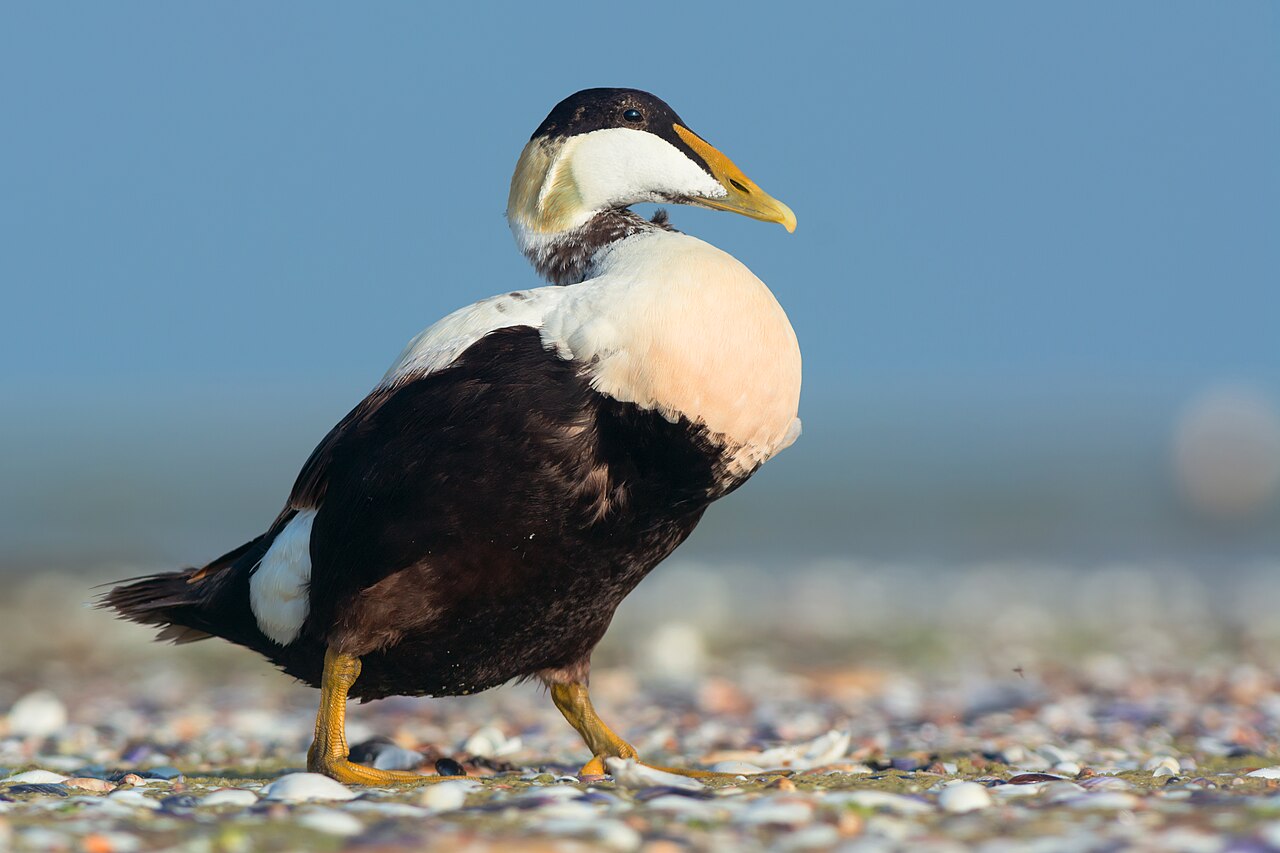
A heavy, thick-set sea duck that almost never leaves salt water, the eider rides the swell in long dark lines beyond the breakers and hauls mussels off the seabed whole. Drakes are startling black-and-white with a green wash on the neck; females stay brown all year, pressed flat on a nest scrape among dune grass. The Wadden Sea is its stronghold — and the place where its decline is most visible, with Dutch breeding numbers down from about 10,000 pairs in the mid-1990s to roughly 3,500 today.
How common eiders migrate
Eiders breeding along the North Sea coast are largely sedentary and can be seen year-round. The great movement in this flyway is not a north-south migration but a moult migration: birds from the Baltic arrive in the Wadden Sea from around mid-June and moult there from July to early September, when they are flightless and depend on undisturbed, shellfish-rich sandbanks. In July and August more than 80% of the eiders in the Danish and German Wadden Sea are males. Some return to the Baltic soon after moulting; many stay the winter. In the Netherlands the species is present in strength from September to April, with the largest passage counted in November. The pattern is not fixed — ringing from the Danish colony of Ertholmene shows those birds wintering further west in 1990–2002 than in 1970–1989 — but the dominant story is loss: numbers across the Wadden Sea fell 43% between 1987/88 and 2019/20, tied closely to depleted mussel and cockle stocks rather than to any change of destination.
Key facts
- Length
- 50–71 cm (sources differ)
- Wingspan
- 95–105 cm
- Leaves
- Mostly does not leave — North Sea breeders are resident. The main movement is the moult migration of Baltic birds into the Wadden Sea from mid-June
- Returns
- Moulting and wintering birds return to the breeding areas in spring; Dutch numbers run high from September through April
- Winters in
- Coastal salt water of the Wadden Sea, North Sea and Baltic; the Dutch mid-winter total is 28,100–99,000 birds
- Changing habits
- Wadden Sea numbers down 43% (1987/88–2019/20) and Dutch breeders down from about 10,000 pairs to 3,300–3,800, tracking depleted shellfish stocks; German breeding numbers meanwhile rose
- Population
- 3,300–3,800 breeding pairs in the Netherlands (2024); roughly 1,000–1,900 in Germany depending on the source
Is migration happening right now?
Weather radar over the Benelux and Germany measures how many birds are aloft, updated every five minutes. See it for Belgium, the Netherlands or Germany, or watch every tagged bird on the live map.
Tracking data from open CC0 and CC-BY studies published on Movebank; each bird's page credits its study.